
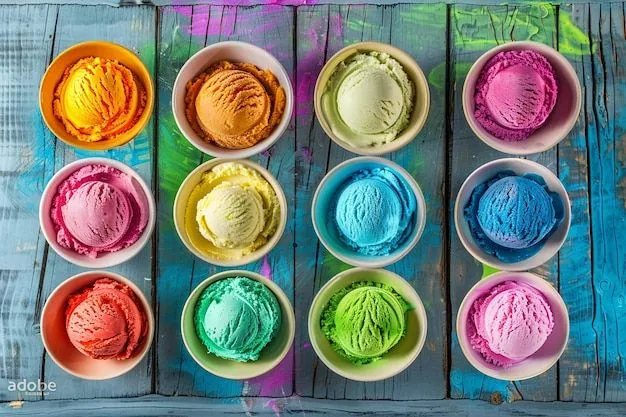
When selecting food coloring for the production of ice cream, it is important to consider the entire formulation and manufacture process. The ingredients of frozen desserts, including milk, cream, fats, sugars, stabilizers and flavors, may affect the appearance of a color. There may be additional considerations for freezing and storage. Consequently, manufacturers should consider the shade, dispersion, processing conditions, stability and compatibility before giving approval for commercial ice cream production of any natural color.
Start With the Desired Shade
The first step is to identify what form of ice cream you wish to achieve. Depending on formulation and product concept, different products can be produced in soft or brighter pastel shades or in deeper colors.
Color choices must be made considering the color appearance after incorporation of all ingredients. A concentrated sample can be very different when distributed over an ice cream mix.
The manufacturers should therefore set a realistic goal or reference standard before making comparisons of color ingredients.
Understand the Ice Cream Matrix
An ice cream is a complex food system, which consists of water, milk solids, fat, sugar, stabilizers, emulsifiers and other ingredients. These parts can play an impact in how a natural color appears and how it disperses.
Fat content is especially important because there are some color preparations that are incompatible in fat-based systems but are compatible in water-based systems.
When selecting food coloring for ice cream , manufacturers should consider the complete formulation rather than choosing a color based only on its general application range.
Consider Color Format
Natural colors may be furnished in various forms, such as powder, liquid, emulsions, and other products. The suitable format will depend on the production process and the mix of the ice cream.
A color should be spread out uniformly in a mix, so that no particles or uneven patches can be seen. Manufacturers are therefore advised to consider solubility, dispersion, concentration, handling and recommended application conditions.
Preliminary trials can help to establish which format is most conducive to the production process.
Evaluate Processing Conditions
Ice cream processing includes several steps prior to the final ice cream product being frozen. Formulation performance may be affected by mixing, homogenization, pasteurization, cooling, aging, freezing and hardening.
A natural color that has been exposed to heat during the pasteurization process should be taken into account. The ingredient should be tested after the appropriate processing step and not just before heating.
Also, manufacturers have to take into account what the color looks like after it has been frozen and then stored.
Assess Color Stability During Storage
Frozen storage process: Frozen storage is a process in which the food is placed in a freezer at a desired temperature, allowing the water within it to freeze. The appearance of the final product can be affected by temperature, light, oxygen, packaging, storage time, and other factors.
The color should therefore be assessed after the product has been frozen and stored under conditions which reflect its intended distribution and retail environment.
If necessary, manufacturers can compare samples stored over varying lengths of time and detect any changes in shade or appearance.
Match the Color to Other Ingredients
Fruit preparations, cocoa, flavors, inclusions and sauces are all commonly used ingredients in ice cream formulations. These can alter the end color or cause interactions that wouldn’t be apparent in a basic color sample set.
The selected color should be tested in the full recipe by product developers. It helps to understand how the drug will look in its final form and to see if you need to adjust the dose.
The objective should be one that is uniform and compatible with the full formula.
Use Application Trials
A structured trial can help manufacturers compare natural color options. Each candidate can be tested at controlled dosage levels using the same ice cream base and processing conditions.
When evaluating Ice Cream Colour, useful observations include shade, dispersion, processing response, frozen appearance and stability during storage. These test steps show key shifts you might miss when looking at strong mix samples by themselves. This smart path lets the tech team pick a good part based on real work, not just vendor notes or how a quick test looks in a small cup.
Consider Supplier Support
When introducing a new formulation of a frozen dessert with a natural color, technical support assistance can be helpful. Application information, recommended dose ranges, storage instructions and product specifications may be supplied.
Quality documentation should be reviewed by manufacturers prior to commercial use of an ingredient. Specifications will help with future purchasing and batch-to-batch quality control.
Conclusion
The color selection for ice cream production should be based on the whole formulation, taking into account ingredient compatibility, processing, freezing and storage. It is advisable for manufacturers to experiment with the different color options in the finished ice cream base and to test how the base performs in a realistic production scenario. A methodology trial can be used to determine the most appropriate application of an ingredient and its dosage. For businesses seeking alternatives to artificial dyes, they can find the options available at FoodRGB.com and have an appropriate technical partner explain the specific needs for the frozen dessert product.